
This story is adapted from a chapter in Buffalo Bayou, an echo of Houston's wilderness beginnings by Louis F. Aulbach.
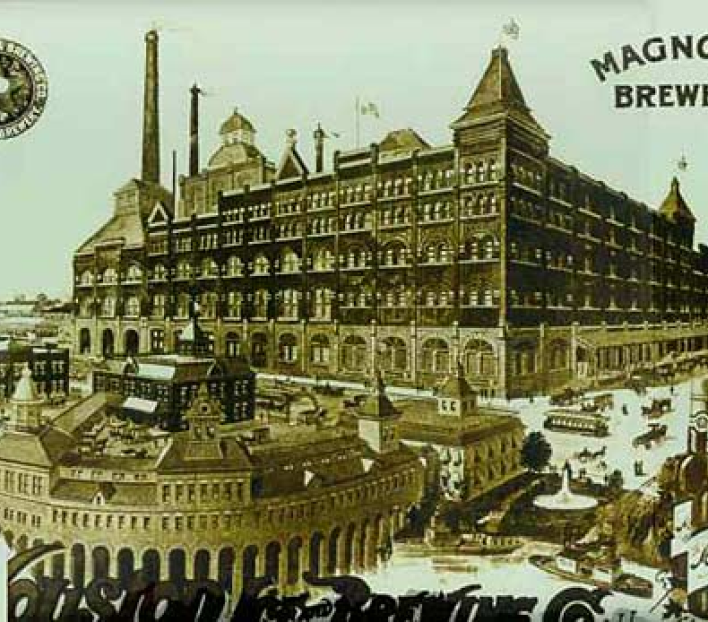
The remnants of one of the largest and most famous breweries of Houston lie immediately downstream of the Franklin Avenue bridge. Several structures on the south bank of the bayou have survived from the late nineteenth and early twentieth century when the Houston Ice and Brewing Company operated the Magnolia Brewery at this location, and by 1903, nearly 200,000 barrels of fine quality beer were produced annually for thirsty Houstonians.
The Houston Ice and Brewing Association was incorporated in 1887, with Hugh Hamilton as the president of the company, Bertrand Adoue as the vice-president and Hyman Prince as the secretary and treasurer. The story, however, begins much earlier and it revolves around the company's founder Hugh Hamilton and his expertise in the ice manufacturing business which was critical to the commercialization of breweries and the growth of the beer industry.
Beer, historically, was a warm beverage. In the United States, the first lager beers were produced in the early 1840's. Jonathan Wagner is credited with making the first lager beer in North America in Philadelphia in 1842. As spring ales, they were brewed in the winter and allowed to ferment in the cold air of winter. Lager beer is brewed in cool conditions with a slow acting yeast, then stored (“lagered”) in cool conditions to clear the beer of particles and flavors. Brewing usually was a family operation and was done on a small scale. These were craft brewers.
For industrial production, brew masters had to move away from the craft brewing techniques. The brew masters had to exercise a high degree of control over the temperature of the beer so they could brew the beer all during the year, not just in the cooler months. Many brewers used natural ice in their operations. Ice was cut in the winter from frozen streams and lakes in the north and stored in sawdust insulated containers until it was needed. However, the year round production of lager beer required a level of ice production that could not be maintained through ice harvesting alone.
By 1877, there were three breweries in Houston. Frederick Hahn had a brewery at the corner of Crockett Street and Beach Street. Gerhard Schulte had taken over the operation of his brother's brewery about 1866 at the same location on San Jacinto Street. John Wagner and Charles Hermann were proprietors of Gabel's brewery on Preston Avenue.
At this same time, the other component necessary for commercial brewing was beginning to appear in Houston. Elisha Hall and R. R. Everett established the Houston Ice Manufacturing Company. The ice house, or manufacturing facility, was located on the north side of Buffalo Bayou, near the City Water Works.
The increased availability of ice and refrigeration had its effect on the breweries of Houston. The beer business was changing. Houston's brewery, owned by Gerhard Schulte, enhanced its offerings of locally brewed beer with beer from the W. J. Lemp Company of St. Louis, Missouri.
The Houston Ice and Brewing Association continued to grow. Hugh Hamilton's expertise in ice manufacturing and the growing demand for quality lager beer in Texas drove the company's expansion along Buffalo Bayou.
Nearly 200,000 barrels of fine quality beer were produced annually by the Houston Ice and Brewing Company at its Magnolia Brewery location along Buffalo Bayou.
The Magnolia Building, located at the corner of Franklin and Milam Avenues, was redesigned by H.C. Cooke and Co. The building, which still stands, was constructed in the footprint of a former structure known as the Franklin Building.
Bart Truxillo purchased the building in 1968 from a bank trust and immediately began its restoration, preserving this important piece of Houston's brewing history for future generations.